AI Image Generation in 2026 Has Changed Everything
If the last time you seriously tried an AI image tool was sometime in 2024, you owe yourself a second look. The jump in quality between then and now is not incremental — it is generational. Native 4K output, text that actually renders correctly inside images, real-time knowledge grounding, generation speeds measured in seconds — the tools that felt cutting-edge eighteen months ago look like first-generation prototypes by comparison.
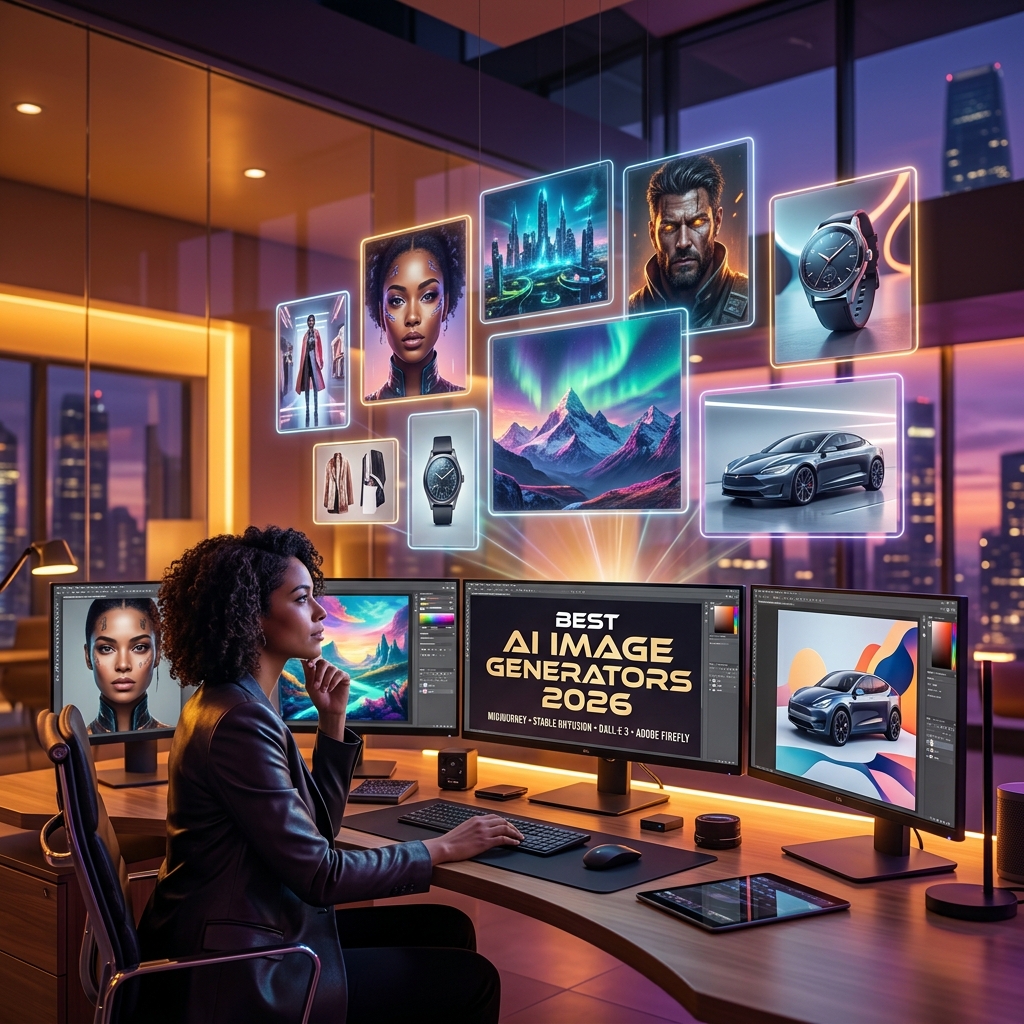
Four tools are dominating the conversation in 2026: Grok Imagine from xAI, ChatGPT Images (powered by GPT Image 1.5) from OpenAI, Nano Banana 2 from Google, and — the newcomer that surprised everyone — Qwen Image 2.0 from Alibaba. Each one represents a genuinely different philosophy about what AI image generation should do. We are going to break all four down in detail, then cover the rest of the field, then give you a complete breakdown of every meaningful free option available today.
Let's get into it.
---
🔥 The Four Hottest Tools Right Now
1. Grok Imagine (xAI / Aurora) — The Bold, Fast Disruptor
Grok Imagine is the one that broke the internet. Launched as Grok Imagine 1.0 in February 2026, it is powered by xAI's proprietary Aurora model — an autoregressive mixture-of-experts network trained on billions of internet examples, built for photorealistic rendering and precise prompt interpretation. The platform generated 1.245 billion videos in January 2026 alone. That number tells you everything you need to know about the demand.
What sets Grok Imagine apart is attitude. It leans into expressive, bold, and boundary-pushing outputs in a way that more cautious competitors simply do not. Grok Imagine supports text-to-image generation, natural language image editing, text-to-video with native audio, image-to-video using up to 7 reference images for visual coherence, and full video editing and extension. For social media creators, short-form video marketers, and anyone who needs rapid concept iteration with a punchy visual style, nothing on the market right now is faster or more creatively freeing.
The Aurora model handles everything from ultra-realistic photography to anime, oil paintings, and pencil sketches. Independent benchmarks have ranked it first in image-to-video and video editing categories. It is particularly strong at capturing scene-level mood, physical realism, and creative atmosphere — excellent for rapid prototyping and social media content. Grok Imagine is also the best-priced tool in the current top ten, with API access at around $0.02 per image, undercutting most competitors by a meaningful margin.
One important note: full image and video generation moved behind a paywall in March 2026. The free tier has been eliminated. Full features require a SuperGrok subscription.
Best for: Social media creators, video content, bold visuals, rapid iteration, retro anime and cyberpunk aesthetics. Pricing: SuperGrok subscription required. API from ~$0.02/image — best price in the top-tier category.
---
2. ChatGPT Images / GPT Image 1.5 (OpenAI) — The Precision Powerhouse
If Grok Imagine is the disruptor, ChatGPT Images is the finisher. OpenAI's GPT Image 1.5 currently sits at the top of the Artificial Analysis Arena with an ELO of 1,278, ranking first across multiple independent leaderboards. It is the most capable general-purpose text-to-image model for precise, instruction-faithful outputs — and the April 2026 update to GPT Image 2 (gpt-image-2) pushed it even further, introducing a native reasoning loop that plans layout mathematically before pixel generation ever begins.
The headline numbers: text rendering accuracy of approximately 95% across five non-Latin scripts, generation speeds up to 4x faster than earlier versions, and the ability to output up to eight consistent images from a single prompt. When you describe a complex scene with specific lighting, multiple subjects, exact spatial arrangements, and a particular mood, it delivers. Dense text, logos, signage, infographics, UI mockups, and product packshots all render reliably — something that was simply not possible from any model as recently as late 2024.
OpenAI has redesigned the Images experience inside ChatGPT with a dedicated creative interface, preset styles, and a Thinking mode toggle available on Plus and Pro plans. The workflow feels like a collaborative conversation, not a command terminal. You describe what you want, iterate in plain language, and the model makes exactly the changes you asked for while keeping everything else intact.
For anyone already on a ChatGPT paid plan, there is zero additional friction. The free tier also includes limited daily access to GPT Image 1.5.
Best for: Precise prompt adherence, text-in-image, product mockups, infographics, UI design, multilingual typography, anyone already using ChatGPT. Pricing: Free tier with daily limits. Included in ChatGPT Plus ($20/month) and Pro ($100/month). API available as gpt-image-2 from $0.006/image (low quality) to $0.211/image (high quality).
---
3. Nano Banana 2 (Google / Gemini 3 Pro Image) — The Knowledge-Powered Realism King
Nano Banana 2 is Google's February 2026 flagship image model — the internal codename for Gemini 3.1 Flash Image — and it does something no other model on this list can replicate. Because it is built on Google's infrastructure, it understands what specific real-world entities actually look like without you needing to describe them. Ask for a specific landmark, a period-accurate historical scene, a recognizable product, or a cultural reference with correct supporting details — and it delivers.
In independent benchmark testing, Nano Banana 2 was given a prompt recreating a specific historical speech. It produced not only the central figure accurately but also included the supporting figures actually present at that event, correctly rendered period-accurate flags, and got the text on visible signs right — something no other model achieved in the same comparison. That is knowledge grounding doing real work.
Nano Banana 2 currently holds an ELO of 1,264 on Arena.ai (from 4.5 million votes), putting it in a genuine neck-and-neck race with GPT Image 1.5 for the top benchmark slot depending on which leaderboard you weight. It generates natively at 4K resolution, combines Flash speed with Pro quality, and integrates image search grounding for real-time accuracy during generation.
And the free tier is simply unmatched: 100 images per day through the Gemini app, no credit card, no paid plan. For developers, the API offers 500 free requests per day. Nothing else in the AI image category comes close on free-tier generosity.
Best for: Photorealism, knowledge-grounded imagery, historical and cultural accuracy, real-world entity rendering, developers on tight budgets. Pricing: Free via Gemini app (100 images/day). Gemini Advanced at $19.99/month. API via Google Cloud (~$0.08/image for 4K).
---
4. Qwen Image 2.0 (Alibaba) — The Sleeper Hit That Topped the Leaderboard
Nobody outside the open-source AI community was talking about Qwen Image 2.0 before February 10, 2026. Within weeks of its launch, it had claimed the #1 position on AI Arena's blind human evaluation leaderboard in both text-to-image generation AND image editing simultaneously — something no model had ever achieved before. This is the tool that quietly beat Midjourney, FLUX, and GPT Image on the benchmark that actually matters: what humans prefer when they do not know which model produced the image.
#### How Qwen Image 2.0 Actually Works
Understanding Qwen Image's architecture explains why it performs the way it does. The model uses a separation of concerns approach: an 8B Qwen3-VL encoder handles language and image understanding, feeding semantic meaning and contextual relationships from your prompt into a 7B diffusion decoder that generates the actual pixels. This encoder-decoder split is what enables the model's unified generation-and-editing capability — the same model that creates images from scratch also edits them with surgical precision.
For editing specifically, Qwen Image employs a dual-encoding mechanism. Semantic encoding (via Qwen2.5-VL) processes the input image to extract high-level conceptual content. Reconstructive encoding (via VAE) captures low-level visual details and texture. When you edit an image, the model preserves the essential character and structure while making exactly the changes you asked for — without the surrounding context falling apart.
Text rendering uses a progressive curriculum learning approach. Training starts with simple images containing no text, then gradually increases complexity — simple captions, then multi-line layouts, then paragraph-level semantics, then complex bilingual designs. This is why Qwen Image handles Chinese characters, calligraphy, and mixed-language layouts at a level no Western-developed model can currently match.
#### What Makes Qwen Image 2.0 Special
Professional typography at scale. Qwen Image 2.0 supports prompts up to 1,000 tokens specifically to accommodate complex text-heavy visual instructions. You can generate complete infographics with charts, flow diagrams, data tables, and properly formatted bilingual text in a single generation pass. PPT-style slides, movie posters, comics with dialogue bubbles, calendars with correct date layouts — all from one prompt, no post-production cleanup required.
Unified generation and editing in one model. Previous versions of Qwen Image required separate models for creating versus editing images. Most major competitors still work this way — FLUX generates but does not edit natively, Midjourney generates but does not edit, and you end up chaining multiple tools together. Qwen Image 2.0 unifies both into a single architecture. The practical result: simpler workflows, less quality degradation from passing outputs between models, and lower overall costs.
Smaller and faster despite doing more. Qwen Image 2.0 reduced its parameter count from 20B to 7B — a 65% reduction — while outperforming its predecessor across every benchmark. It also outperforms FLUX.1 (which has 12B parameters) on DPG-Bench, scoring 88.32 versus FLUX's 83.84. A 7B model runs faster, costs less to serve at API scale, and is within reach of consumer GPUs (24GB VRAM) for local deployment.
Bilingual text rendering is genuinely best-in-class. In benchmark testing, Qwen Image achieved over 90% accuracy in bilingual text editing, maintaining font styles and layouts across both English and Chinese characters. No other model comes close for Chinese-language image content.
Native 2K resolution. Output generates natively at 2048×2048 — not upscaled from 1024. Native generation means the model is actually rendering fine detail during creation, producing output that is closer to production-ready without post-processing.
#### Qwen Image Layered — The "Photoshop of AI"
Alibaba also released a companion model called Qwen-Image-Layered that deserves its own mention. Using proprietary RGBA-VAE technology, it assigns transparency to each element during generation, producing physically isolated layers rather than flat pixel files. This means you can recolor, resize, rotate, or delete specific objects without the rest of the image deforming — the core problem that has made AI image editing frustrating for professional designers since day one.
The model automatically decomposes images into 3 to 10 layers depending on scene complexity. For e-commerce product photography, the photographer shoots one base image and AI handles the rest. For game development, it generates sprite images with transparent channels ready to drag directly into a game engine. For comic translation, it separates dialogue bubbles, characters, and backgrounds so translators can edit text without touching the art.
Best for: Typography-heavy designs, infographics, PPT slides, posters, comics, bilingual content, developers who want unified generation and editing in one API call, anyone who needs Chinese-language image text. Pricing: API access via Alibaba Cloud BaiLian. Open weights available on Hugging Face under Apache 2.0 license — meaning free for commercial use, modification, and local deployment. Access: Try at qwen-image.net or via Qwen Chat (select "Image Generation"). API via Alibaba Cloud.
---
🏆 The Rest of the Field — Still Essential in 2026
Midjourney V8.1 — The Artistic Gold Standard
Midjourney V8.1 arrived April 30, 2026 as the fastest Midjourney model ever, with standard jobs rendering 4 to 5 times faster than previous versions. The V8 line launched in alpha on March 17, 2026 on a completely rewritten codebase, bringing native 2K resolution via the --hd flag and dramatically improved anatomy rendering — hands, fingers, and facial features are noticeably more accurate. Text rendering improved significantly in V8 versus V7 but still trails GPT Image 1.5 and Qwen Image 2.0 meaningfully on benchmark accuracy (around 71% in V7, improved in V8 but still below the 95% GPT achieves).
Midjourney's unique strength remains its aesthetic intelligence. A simple prompt like "abandoned greenhouse" yields a moody, perfectly lit, cinematic result that other models simply cannot replicate at the same level. The sense of intentionality in the lighting, composition, and texture is what keeps creative professionals coming back.
No public API. No free tier. Subscription only.
Best for: Editorial, concept art, cinematic imagery, artistic projects, premium brand aesthetics. Pricing: From $10/month. Commercial rights on all paid tiers.
---
Adobe Firefly Image 3 — The Only Commercially Safe Option
Training exclusively on licensed content makes Firefly the only model with formal commercial indemnification — the critical advantage for any professional deploying AI images in paid client work. Photoshop integration (Generative Fill, Generative Expand) remains transformative for working designers. Adobe removed the free generative credits tier in early 2026, so a paid plan is now required.
Best for: Commercial design, advertising, licensed content for client work. Pricing: From $9.99/month standalone or via Adobe Creative Cloud.
---
FLUX 1.1 Pro / FLUX 2 Pro (Black Forest Labs) — The Developer Backbone
FLUX consistently delivers some of the highest photorealism scores in 2026, with generation times now under 1 second after a March 2026 speed upgrade. It holds four of the top nine spots on some leaderboards across different quality tiers. The public API, open-source weights (FLUX Dev, FLUX Schnell), and ComfyUI compatibility make it the most practical choice for developers building image features into their own products. Self-hosted FLUX Dev scores within 19 ELO points of the premium FLUX 2 Max.
Best for: Photorealism, developer pipelines, self-hosting, product photography. Pricing: API from ~$0.03-0.05/image. Open-source versions free with own compute.
---
Ideogram 3.0 — The Typography Champion
Ideogram built its entire identity around text-in-image accuracy and remains the specialist choice in 2026. For posters, banners, social cards, logos, and designs where legible, stylistically-matched typography is the centrepiece, Ideogram is still the dedicated tool. It offers a genuine free tier (10 credits/week), a Batch Generator for spreadsheet-driven bulk creation, and solid overall image quality beyond just the text use case.
Best for: Text-heavy designs, posters, banners, logos, social graphics. Pricing: Free tier (10 credits/week). Paid from $8/month.
---
📊 Full Model Comparison Table
| Tool | Best For | Text Rendering | Native Resolution | API | Free Tier | Approx. Price/Image |
|---|---|---|---|---|---|---|
| GPT Image 1.5 / 2 | All-round precision | ✅ ~95% accuracy | 2K | ✅ Full REST | ✅ Limited daily | $0.006–$0.211 |
| Grok Imagine | Bold visuals, video | ✅ Good | 1K-2K | ✅ | ❌ Paid only | ~$0.02 |
| Nano Banana 2 | Photorealism, knowledge | ✅ Excellent | 4K | ✅ | ✅ 100/day FREE | ~$0.08 |
| Qwen Image 2.0 | Typography, editing | ✅ Best-in-class bilingual | 2K native | ✅ | ✅ Apache 2.0 OSS | Alibaba Cloud |
| Midjourney V8.1 | Artistic aesthetics | ⚠️ ~71%+ | 2K (--hd) | ❌ | ❌ | $10+/mo subscription |
| Adobe Firefly | Commercial safety | ✅ Good | 1K-2K | ✅ | ❌ | From $9.99/mo |
| FLUX 2 Pro | Photorealism | ✅ Good | 1K-2K | ✅ | ✅ OSS self-host | ~$0.03–$0.05 |
| Ideogram 3.0 | Typography specialist | ✅ Best-in-class | 1K-2K | ✅ | ✅ 10 credits/week | From $8/mo |
| Stable Diffusion 3.5 | Full control / OSS | ⚠️ Improving | Up to 2K | ✅ Self-host | ✅ Free local | Free (own GPU) |
---
🆓 Best Free AI Image Generators in 2026 — Full Breakdown
Free AI image generation has matured to the point where several tools now produce professionally usable outputs without any paid plan. Here is a complete, honest breakdown.
Google Gemini / Nano Banana 2 is the undisputed king of free tiers. You get 100 images per day through the Gemini app at native 4K quality — no credit card, no paid subscription. For developers, the API offers 500 free requests per day. Nothing else comes close in quality-per-free-image.
ChatGPT Images (Free Plan) gives access to GPT Image 1.5 with daily limits. Excellent for images requiring readable text, UI mockups, and marketing materials. A few images a day is completely viable on the free tier.
Qwen Image (Open Source) is available on Hugging Face under the Apache 2.0 licence, meaning you can run it locally for free with commercial rights. For developers and power users with capable hardware, this is effectively unlimited free image generation from a model that currently tops the AI Arena blind evaluation leaderboard.
Microsoft Designer / Bing Image Creator is powered by DALL-E technology. 15 fast-generation boosts per day with unlimited slower generations afterwards. A Microsoft account is all you need — no payment information.
Leonardo.ai gives approximately 150 free tokens per day across multiple models including FLUX, with no watermark on outputs. Strong for stylized, anime, and concept art with multiple specialized model families.
Ideogram offers 10 free credits per week — limited in volume but excellent quality, especially for text-heavy designs. No credit card required.
Canva AI includes image generation within the Canva free plan. The unique advantage is generating directly inside your design without any export/import step.
Craiyon (formerly DALL-E Mini) is the only truly unlimited free AI image generator. No credits, no daily limits, no account needed. Quality is lower and generation is slower, but for zero-friction concept sketching it is the easiest possible starting point.
Pollinations.ai is the best privacy-first, zero-account option. Open-source, no watermarks, no login.
Stable Diffusion (self-hosted) is unlimited and free with a GPU (12GB+ VRAM). Access to thousands of community fine-tuned checkpoints at zero API cost.
Free Tier Quick Reference
| Tool | Free Images | Signup? | Watermark | Commercial? |
|---|---|---|---|---|
| Nano Banana 2 / Gemini | 100/day (4K) | Google account | No | Check terms |
| ChatGPT Images | Limited daily | Yes | No | Check plan |
| Qwen Image (OSS) | Unlimited (local) | No (self-host) | No | ✅ Apache 2.0 |
| Microsoft Designer | Unlimited (slow) | Microsoft account | No | Yes |
| Leonardo.ai | ~150 tokens/day | Yes | No | Check terms |
| Ideogram | 10 credits/week | Yes | No | Yes |
| Canva AI | Limited | Yes | No | Yes |
| Craiyon | Unlimited | No | Ads only | Yes |
| Pollinations.ai | Unlimited | No | No | Check terms |
| Stable Diffusion local | Unlimited | No | No | Yes |
---
The Secret That Changes Everything: Prompt Quality
Here is the truth every benchmark comparison buries: the single biggest variable in AI image quality is not the model. It is the prompt. A vague prompt fed into Nano Banana 2 will produce vague results. A well-structured, specific, thoughtfully crafted prompt fed into that same model will produce something publication-ready.
The best prompts consistently share the following qualities:
For tools like Qwen Image 2.0 specifically, the 1,000-token prompt support means you can describe complete infographic layouts, specify font hierarchy, list each data point you want rendered, and describe the colour palette — all in one prompt. That capability completely changes what structured content generation can look like.
Creators who build a personal library of prompts that reliably produce results for their recurring use cases will consistently outperform everyone who types whatever comes to mind.
---
🚀 Build Better Prompts with Our JSON Prompt Generator
Building great prompts should not require trial and error every single time. Our JSON Prompt Generator gives you a structured, repeatable system for crafting prompts that actually work — across every major platform covered in this guide.
It walks you through subject, style, lighting, mood, camera details, and output settings in a clean, structured JSON format. Works with ChatGPT Images, Grok Imagine, Nano Banana 2, Qwen Image 2.0, Midjourney, FLUX, Ideogram, and more. Instead of staring at a blank text box, you follow a structured process and get consistently stronger outputs from the very first attempt.
👉 Try the JSON Prompt Generator free — no account needed →
---
What Comes Next?
The pace of change in AI image generation right now is faster than at any previous point. Three things are clearly on the horizon.
The gap between image and video generation is collapsing. Grok Imagine's native audio-video pipeline, Midjourney's animation features, and Google's Veo 2 are early indicators. Seamless text-to-video with consistent characters, lighting, and style from a single creative brief is very close.
Image provenance and authentication infrastructure is becoming urgent. Content credentials and AI-detection tools are moving from niche to essential as AI-generated media saturates the open web. Expect them as standard features across all major platforms within the next year.
The creative role itself is shifting. The most effective creators in 2026 are not the ones with the deepest knowledge of model architectures — they are the ones who understand direction, curation, and how to write a clear creative brief. The prompt is the brief. The model is the studio. Getting great at writing that brief is the most valuable skill you can build right now.
Start today — with our JSON Prompt Generator as your foundation.